AI strategy
What AI-mature organisations do differently
The advantage no longer lies in who experiments with AI, but in who deploys it at scale. And that is mostly a matter of organisation, not algorithms.
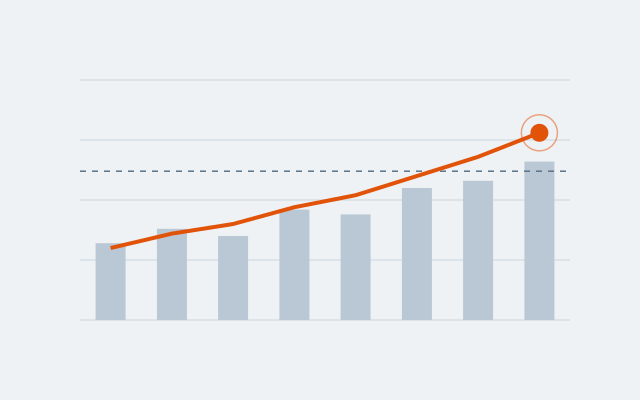
For its AI Maturity Index 2025, IMD studied the 300 largest companies in the Forbes Global 2000. The conclusion is clear: AI transformation is more about alignment than algorithms. Technology has to fit governance, partnerships have to fit purpose, and human capability has to fit ambition. The hundred most mature companies also showed higher growth in revenue and market value than the rest. That is a correlation, not proof of cause, but it is a signal leadership teams should take seriously.
Notably, financial services has 32 companies in the top 100, more than the technology sector itself. AI maturity is not a privilege of tech companies.
Five things the leaders have in common
- Leadership at board level. Leaders do not park AI in an innovation lab. It sits at the leadership table, with a clear owner or AI council steering adoption across functions.
- Organisational readiness. Technology goes hand in hand with training and culture. According to the research, Unilever trained more than 23,000 employees in AI fluency and Visa reskilled 10,000.
- Responsible AI as a competitive necessity. Leaders publish explicit AI principles and set up oversight, not only for compliance but for trust.
- Partnerships. The fastest companies do not build everything themselves; they co-develop with technology partners.
- From efficiency to growth. Where AI first mainly automated, leaders increasingly use it for new products, faster innovation and new business models.
The foundation is still data and process
Watkins and Weissbeck name seven foundations for successful AI: data, processes, technology, governance, talent, training and leadership. Their first piece of advice is the least glamorous: do the dirty work on your data first. But only start cleaning after you have chosen the highest-value use cases, or the budget disappears into an unfocused clean-up.
The same pattern shows up in manufacturing. The most mature industrial companies combine domain knowledge with their own data, integrate AI into core processes such as maintenance and quality, and invest systematically in their people. AI is not a separate project there; it is part of how the factory runs.
Three questions for leadership
Gopi Kallayil, AI strategist at Google, reduces it to three questions every leadership team should ask:
- What is our plan for growth this year?
- What are the priorities and the biggest challenges?
- How can AI enable that strategy?
The order matters. Start with the problem and the desired outcome, and only then ask how AI provides a better solution. Not the other way around.
What this means in practice
In my experience, organisations rarely get stuck on the technology. They get stuck on ownership, data quality and the lack of a measurable goal. Becoming AI-mature therefore starts with three things: an owner at the leadership table, a limited number of use cases with a business case, and a data foundation that can carry them.
Sources
- Yokoi, T., Wade, M. & Shan, J. (2025). IMD AI Maturity Index 2025: AI strategies that are working. IMD, TONOMUS Global Center for Digital and AI Transformation.
- Yokoi, T. & Wade, M. (2025). AI maturity in manufacturing: lessons from the most successful firms. I by IMD, 9 August 2025.
- Watkins, M. D. & Weissbeck, R. (2023). The 7 foundations of successful AI implementation. I by IMD, 28 September 2023.
- Kallayil, G. (2025). How can AI enable your business strategy? I by IMD, 1 July 2025.
Read next
Let's talk.
About a role, an advisory question or a workshop for your team on data, analytics, AI and FP&A.